

AIRx is a research and innovation collaborative focused on developing governed AI systems in service of human wellness. We conduct applied research into AI methods and operating models, and we build tools that support collaboration and inquiry at scales not achievable without AI.
AIRx is based in Encinitas, and we begin our work locally by design as a real place with real people, institutions, and accountability. We begin with homelessness because the need is greatest and most urgent. People experiencing homelessness face overlapping medical, psychological, and social challenges within fragmented systems where coordination is difficult and decisions carry immediate human consequences. Homelessness in Encinitas is our first collaboration.
This collaboration is centered on the people who are experiencing homelessness in Encinitas, those who have experienced it, and the volunteers, friends, and families who experience this alongside them. We are part of this collaboration. We bring our lived experience, relationships, and shared responsibility. Our role is to contribute enabling capacity—research, coordination, and AI tools—where they improve well-being.
A Systems Approach to Homelessness
Homelessness is not the result of individual failure. It is a systems problem—one that emerges when health care, housing, behavioral health, outreach, and social services operate without effective coordination.
The work of Community Solutions, through the Built for Zero initiative, demonstrates that communities can make meaningful progress when they align around shared responsibility, coordinate across providers, and commit to learning from real outcomes. Central to this approach is knowing the people experiencing homelessness as people.
This methodology emphasizes coordination among providers, the use of shared information to guide action, and continuous measurement of outcomes. Progress is driven by learning loops: communities test approaches, observe results, and adapt together based on what is working and what is not.
Leveraging AI to Improve Wellness
AIRx pioneers AI to enable collaboration, learning, and coordination in complex human systems. In the context of homelessness in Encinitas, AI is applied to help the collaboration better understand lived experience, align action across providers, and learn from outcomes over time.
This includes using AI to support structured conversations and interviews that preserve narrative, context, and dignity. It also includes synthesizing qualitative and quantitative information across fragmented systems and surfacing patterns that help guide collective decision-making. These capabilities are applied to reduce friction, deepen shared understanding, and focus effort where it can most improve well-being.
By working with complex data at unprecedented scale, we strengthen learning loops—observing outcomes, reflecting together, and adapting—AI helps the collaboration move with greater clarity and responsiveness. AIRx contributes this enabling capacity as part of the collaboration, in service of progress defined by the community itself.
AI Design Practice and Human Rights Stewardship
AIRx applies AI within a framework of rigorous process, continuous learning, and respect for human rights. When AI is used in contexts that affect people’s lives and well-being, it must be auditable, accountable, and subject to ongoing reflection and correction.
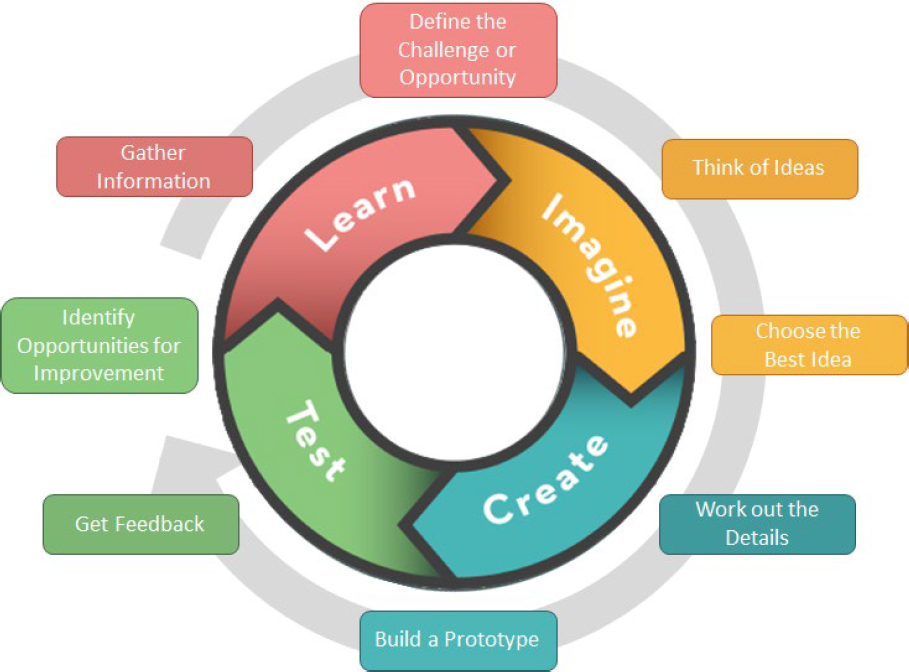
The MIT D-Lab design process.
National Academies of Sciences, Engineering, and Medicine. 2025. https://doi.org/10.17226/7.
We use established research and design practices that emphasize iterative learning: observing outcomes, reflecting with stakeholders, adapting approaches, and repeating. This orientation supports transparency and shared responsibility, particularly in complex systems where interventions can have unintended consequences.
AIRx applies human-centered principles including attention to agency, dignity, and fundamental rights. These principles function as design constraints: AI systems must support human judgment, avoid harm, and respect the lived experience of those most affected.
By embedding audit, reflection, and human rights considerations into how AI is developed and applied, AIRx aligns technological capability with ethical stewardship and public trust.